
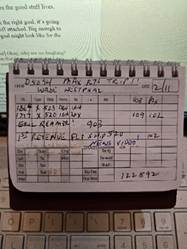
Captain’s Log: UA 1777, February 11, 2021. B-737 MAX 9 Return to Service Flight. And the very first revenue flight ever in this airplane – a remarkable flight indeed! Passengers – 102, Crew – 7, 109 Souls On Board. I would not have been on it without multiple influencers who turned me to face different directions during those critical formative years of high school and college.
I spoke about a couple of them during my last speech before the Covid lockdown of 2020. The idea I’d chosen for this audience, the Rocky Mountain Regional Turf Grass Association (they work on golf courses and sports fields), was about doing hard things – because that’s where the good stuff is!
It’s not at all an original thought, or even a recent one. President John F. Kennedy was one of many thought leaders who’d invoked it. I think of a particular instance, way back in the early ’60s, when he was making his case to the country about his big dream to go to space. He said, “We do these things not because they are easy, but because they are hard.” He understood that if we are willing to do hard things, we can live big lives that are abundant.
And here was my set up for the audience in Denver: “Here’s something that I’ve observed about life in general over the course of my 60 years on the planet. Maybe you have, too. It’s been my observation that life is generally good. It’s also generally hard, and I think there might be a relationship there. So today I encourage you to seek out hard things as big dreams, because that is where the good stuff lives.”
Then I continued…
So let’s see. Big dreams, big goals. What might that look like? Well, if you pick the right goal, it’s going to be big, it’s going to look hard, and importantly, it’s going to have a big payoff attached. Big enough to be worth it. So let’s see if we can figure out what a nice, big, fat, worthwhile goal might look like for the Rocky Mountain region.
By December of 2019, the Denver Broncos had endured a rough season. So I brought them up as an example of engaging with all those criteria I just mentioned.
“How about a Super Bowl for the Broncos?” Everyone in the room got the joke, which was a good sign. Most keynote speeches can be judged for success in whether there’s translatable humor for the crowd. So far, so good in that regard. I pressed on…
“Wait – why are we laughing? Okay, I get it, we’re 5 and 8. It’s a nice dream. I’m not going to give up on that dream just yet, but I am willing to set it gently over here on a shelf and come back to it in the fall.”
And that was the beginning of my transition into the lesson of the day.
“But while we’re talking about Super Bowls, let’s talk about another Super Bowl. Let’s go back to 1972 and Super Bowl VI. It occurs to me that you might have a hard time going back to 1972 if you’ve never been to 1972, so quick round of applause if you were not even alive in 1972. [big applause] Oh my goodness! So many clapping. That’s happening more and more these days.
So quick history lesson for those of you who weren’t on the planet. Super Bowl VI was Dallas Cowboys versus the Miami Dolphins. Back then, as is true today, it was customary for somebody to come out and sing the national anthem to get things going. On that day, it was the Air Force Academy Cadet Chorale, and they did a fantastic job with “The Star-Spangled Banner.” As they finished the last note, here came the Thunderbirds, the Air Force demonstration team, in their big fat F-4 Phantom Jets, roaring across the field with black smoke trailing behind.
That was a really exciting thing for a seventh-grade kid like me, watching all this on television, sitting in my armchair in a small town in central Georgia while over on the other side of the living room was my dad in his rocking chair, smoking his pipe. No, it wasn’t that kind of pipe. [laughter] It was a tobacco pipe. Perhaps you’ve seen a picture.
So Dad’s over there smoking his pipe. I’m over here watching all this on television. As soon as the Thunderbirds finished their fly-over I looked at Dad and said, “Boy, those Air Force Cadets, they’re cool! Too bad I could never be one of them.”
And this is what he did not say. “Yeah, you’re probably right. You’re just a small-town kid from a working-class family. You leave home, do your couple years of community college, and start your “normal” life from there.”
No, he didn’t say that. What he did say was…
“Why not?”
He knew that if he let me fight for my limitations, that I’d get to keep them, and he didn’t want to have anything to do with that battle.
Let me say that again. If we fight for our limitations, we get to keep them.
“Why not?” One of the most powerful questions in the English language.
The Air Force Academy had never even occurred to me, but Dad had planted a dream in my head that I could get my mind around, I could believe in, that would take me ultimately to the Air Force Academy, to the Air Force itself, to the airlines, and finally here to have this conversation with you today.
Another show of hands. Who here has heard of Napoleon Hill? What book did he write? Yes! Think and Grow Rich. In that very famous book, Hill wrote that whatever the mind can conceive and believe, it can achieve.
Simple, right? Sure. But not necessarily easily.
WHATEVER! But here’s the disclaimer. Stuff happens. Sometimes things get in the way, and it might take a while for the good stuff to show up. And that’s why we understand these big dreams and goals to be hard.
Now I had this big dream and no idea how to bring it into reality. We didn’t have Google in 1972. [laughter] So I went and talked to my school counselor, and of course, she knew exactly what I needed to do. She wrote out a plan for me, and I stepped out on that plan. I started to take all the right classes instead of the fun classes. I’d get up before breakfast and put on my hunting boots and go out and run for a mile. I did those kinds of things for four and a half years, from seventh grade to eleventh grade, getting ready for my senior year at high school, when I could then apply to go to the Air Force Academy.
Finally, I was a senior and it was time to apply to join the Air Force Academy Class of 1981. The first step was to call my congressman. What? Yeah, you can’t even apply to the military academy til you get a nomination from a congressman. So I wrote off to my congressman, Jack Flint. He kindly wrote back asking for a little more information, and I took that letter, set it on my desk where I do my homework, and it sat. And it sat.
A couple of weeks later, Dad called me into the kitchen and said the congressman’s office had called wondering if I had received that letter because they hadn’t received my response yet. I said, “Yeah, I got it. It’s on my desk there.” Dad’s fist came down on the kitchen table. “Boom!” “That letter needs to go out tomorrow. The congressman has a deadline, and if he misses his deadline, you’re done. It’s over.”
It never even occurred to me that a congressman might have a deadline. But then I realized that if the congressman has a deadline, I probably have one too, so I’d better get this process going. So I sent back the letter and received the nomination. The next step was to go take a physical. Yeah, we’re not just going off to college. We’re joining the military, so we have to pass the military physical.
So I called up Fort McPherson, the closest Army Base to my house, and made an appointment to go see the old Army doctor. And in creeps this ancient specimen of an Army doctor. Where he had hair, it was white, thin, and greasy. Coke bottle glasses and shaky hands as he shined his light up into my nose, muttered something I couldn’t understand, and sent me away.
A few days later, I got a letter from the Department of Defense Medical Examination Review Board (DODMERB). And DODMERB said because of the issue that the old doctor had muttered about, I had to go see a nose specialist. Okay, we’re looking at multiple doctor appointments here, I can see that. I’m really conscious of my deadline, starting to get a little nervous about time slipping away.
So I called the nose specialist in my little hometown in central Georgia. Now, it really is a small town. We only have one nose specialist. His next appointment wasn’t for ten days. Tick, tock. So ten days later I went over to see him, he shined his light up in my nose and sent me away.
A few days later still, I got the next letter from DODMERB saying, “Good news! The specialist saw none of the issue the army doc was worried about.” However, this nose specialist also happened to be a nose surgeon, and he had reported that I had a deviated septum that needed to be surgically corrected. Seriously? What’s a septum? Apparently, that’s what you call this piece of cartilage that goes right down the middle of your nose and divides it into two nostrils. What’s a deviated septum? Who cares? Have the surgery or forget about the Academy, right?
So I called the guy back up, and his next surgical appointment was three weeks out. Tick, tock,. Three weeks later, I went and had the surgery. Two more weeks for recovery. Tick, tock, tick, tock. He shined his light up my nose one last time. “Yeah, you’re good.” I was able finally to send off my completed application to the Air Force Academy.
The good news was my package was good enough to get into the Academy. The bad news was thatthe Class of ’81 was full. I was too late, and I would not be joining the Air Force Academy Class of 1981.
So at this point, what do you do? Do you simply recognize that, yeah, you really are just a small-town kid from a working-class family with no real business dreaming big? Do you fight for your limitations and step out of the process? Or do you think, “Maybe if I stay in the process, I know it’ll be hard, but I hope it’ll be worth it” and you regroup, knowing that at the end of this process, there’s some really good stuff?
You choose to stay in the process. So you go back and you reenter that same process all over again; you do, in fact, go off to that community college for a year while you write your second letter to the congressman; and of course, there’s another medical exam.
Well, I’m not the brightest bulb on the tree, but I’d learned my lesson about dealing with the old Army doctor, so I went over to Maxwell Air Force Base to see the Air Force doctor. He did his thing, shined his light up in my nose, and very casually asked, “Did you know that you have a hole in your septum?”
And I knew it was over. All of those right classes in high school instead of the fun classes, all those mornings I got up to go for a run, all that paperwork, all those letters to the congressman, all for nothing.
Now, imagine you’re this Air Force doctor, and you’ve got this 18-year-old kid falling to pieces right before your very eyes. And to this day, more than 40 years later, I remember his kindness. He quietly said, “This is really important to you, isn’t it?”
Empathy. Human connection. A tiny spark, a flicker of hope. And he knew something that I did not yet know. He could fix this.
And unlike that old Army doctor, this Air Force doctor told me what his report was going to say. His report was going to say that this was a non-issue. It would have no impact on my ability to serve the United States Air Force in any capacity whatsoever. And weeks later, I was in Colorado Springs, wearing the uniform of an Air Force Academy Cadet in the Class of 1982.
Two things you might take from this experience. One is that my path to the Academy was long. It was hard. Stuff got in the way. But it was worth it. I learned as an 18-year-old kid that the simple act of being determined to stay in the process could take me to incredible places.
But the more important point from this story is that we have the ability to impact other lives in what seem like ordinary, insignificant interactions.
When I’m out there flying my Boeing jets, a heading error of one degree is so small, it’s almost impossible for me to even see it on my instruments. But if I don’t catch it, I’m a full mile off course in less than ten minutes. Imagine the impact of that tiny little error on a long-haul flight halfway around the world. I could literally miss Australia. Just because an issue is small, doesn’t mean it’s insignificant.
That old Army doctor had me in his office for less than five minutes, but the sequence of events that he put into place kept me out of the Academy for a full year. The Air Force doctor repaired all of that damage, and he put me on the path to success.
I invite you to be the Air Force doctor in all of your interactions. Kindness, human connection, a tiny spark, a flicker of hope. Of course, you’re going to be kind to all those players out there on the golf course. But how much more impact could you have if you elevated that poor guy behind the counter at the pro shop? You know, the guy with the phone in the ear, working on the tee sheets and trying to sell golf balls, as frantic as he is? If you were able to make his life a little bit better that day, how many customers would you touch without even knowing about it? Or that coach at that school where you’re creating an awesome playing field? You make his world a little bit better, and now he’s different with all of his players.
Be the person that changes somebody else’s life, somebody else’s world, just a little bit. It’s simple. Not necessarily easy. But there’s so much good stuff in it.
Epilogue
When I entered the Air Force Academy, I was not medically qualified to fly. While I was physically qualified in every other way, my vision was below standard. I had no expectation of ever becoming a pilot.
Then in the fall of my senior year, someone at manpower planning in The Pentagon realized that in seven years, the air force would be short of pilots in my year group. So after three-and-a-half years at the academy, with a stroke of a pen I was qualified to fly and entered the pilot training course track.
Very cool, you might think, and you’d be right. But get this. Remember how I was delayed by a year and had to apply all over again? It turns out that nobody in the Class of 1981 received vision waivers. Nor anybody in the class of 1983. Nor anybody in ROTC or any other commissioning source. Only the Class of 1982 from the USAF Academy received those waivers. Had I been successful my first time around I would not have gone to pilot training, would never have been an airline pilot, and would likely not be writing this book. I am a walking example of how very hard knocks can have very good outcomes if we resolve to stay in the process. Hard things – that’s where the good stuff lives!
Keep reading for more of my conversation with the Turf Grass Association about heroes who helped put me in the cockpit of flight 1777!






![20160220_164734[1]](https://thesymphonyofyourlifeblog.com/wp-content/uploads/2016/03/20160220_1647341.jpg?w=336)




 And the crowd really begins to thin at this point. Climbers who didn’t understand what they were undertaking have a reality check and many turn back. Those who are not ready physically or psychologically, or who are not properly dressed, or who didn’t bring enough water, or who are too old or infirm to climb a steep grade stop here or shortly after. They give up. They know they can’t climb another 500 railroad ties up this massive incline. From here on, the number of climbers heading down to the parking lot is greater than the number going to the top.
 The Symphony of Your Life