A “Symphony of Your Life” blog with Mark Hardcastle
Many years ago one of my pilot buddies was stationed with the military in England. As was often the case, he chose to live on the local economy, and found a room he could rent from a dear old widow who was glad to have a brawny lad around the house.
He happily did odd jobs for her, and in due course noticed that her front step, a single slab of stone, was deeply worn from having been trod upon for who knows how many years.
So one day he took it upon himself to dig it up and turn it over, hoping to present his landlady with a nice smooth surface for her front step.
Only to find when he flipped it that it had already been turned!
Imagine!
I thought of that story last weekend as I was taken to a different place by the Colorado Children’s Chorale. They were singing the Samuel Lancaster setting of John Holmes’ “The People’s Peace.” The line that fired my imagination: “Days into years, the doorways worn at sill…”
How many soles of how many shoes had swept the granite of that stoop at my friend’s lodging? What tidings had they brought? Babes-in-arms carried across; becoming toddlers, adolescents, then young adults wearing at the stone of their own accord. Then old. Then children. Until the tread is worn to the point that it must be turned. And turned again.
The stories that stone might tell! They might begin something like this:
“Summer gives way to fall, but winter always gives way to spring, which must then become summer again. The sun passes from east to west each and every day; each and every night, it passes from west to east again while we sleep.”*
Which sometimes gives us pause when we realize that while days can seem to drag, the years fly by.
Today at the solstice, at the point of mid-winter, enduring the bitterness of cold and the quiet of the long night, we might find ourselves thinking about the turning of the stone. Loved ones long gone and sorely missed may come to mind. And this shortest day, like our lives, is over almost before it begins.
Then what? If you’re like me, you may feel a bit unsettled by what seems in this moment to be a sort of futility of living. Today we might be asking, “why bother with living at all?”
Thankfully, as I heard at Boettcher Hall a few days ago, Holmes and Lancaster and the Children’s Chorale have a suggestion. I think they would offer this, “The People’s Peace” as a reason to bother:
“Peace is the mind’s old wilderness cut down-
A wider nation than the founders dreamed.
Peace is the main street in a country town;
Our children named; our parents’ lives redeemed.
Not scholar’s calm, nor gift of church or state,
Nor everlasting date of death’s release;
But careless noon, the houses lighted late,
Harvest and holiday: the people’s peace.
The peace not past our understanding falls
Like light upon the soft white tablecloth
At winter supper warm between four walls,
A thing too simple to be tried as truth.
Days into years, the doorways worn at sill,
Years into lives, the plans for long increase
Come true at last for those of God’s good will:
These are the things we mean by saying, Peace.”
Our children named, our parents’ lives redeemed: those following in our footsteps together with those who came before us… abide. In our stories within the stone in the doorway. Written yesterday, today, and tomorrow. Remembered and retold around the table at the holidays. Because the years don’t fly into oblivion. Rather, years flow into lives. Creating plans for long increase!
This shortest day, like our lives, is over almost before it’s begun. But the stone in the doorway endures! And tomorrow will be longer, as will the day after. And our lives redeemed through the stories our children will tell.
And so, on this mid-winter day, despite the bitterness of cold, as those long gone are remembered and fondly missed, while wondering at the turning of the stone and the stories it could tell, if we simply choose, we can be warmed and comforted watching the plans for long increase come true at last. Even here, even now, if we stop to look, is peace.
We see it in the clearing of the mind’s wilderness; the stroll along main street; the naming of the children. It’s in the warmth of summer noon gone by and yet to come. The harvest brought in. The table set, the lamps lit, the guests arrived for dinner. The unremarkable yet profound rising and setting of the sun. The turning of the stone. The things that remind us why to bother with living at all: the days into years, the doorways worn at sill. The things we mean by saying, Peace.
This sparkling winter, then, on this, the shortest day of the year, with best wishes for you heartfelt, I offer you… Peace.
You’ll find it in your stories.
Happy holidays!
The Symphony of Your Life
*The Symphony of Your Life: Restoring Harmony When Your World Is Out of Tune, page 7
Mark graduated from the USAF Academy in 1982. After nine years as a pilot on active duty, he left the military to join a commercial airline. Now retired, he no longer flies big jets around the world. He now spends time in the Rocky Mountains and serves on the artistic staff of the Colorado Children’s Chorale. Mark lives in Centennial, Colorado, with his wife and Youngest son, Cameron. The older three are off the payroll! Contact Mark today to schedule a keynote or workshop for your organization! email: mark@symphonyofyourlife.com. 720.840.8361
Captain’s Log: May 1, 2014. Sitting at my desk, my first book newly published, refusing to rest on my laurels. This is the first writing of what will become my second book. How shall we begin?
It’s now late 2024. I am no longer an airline pilot, but I like to think that I remain an author. So what has me writing these days? My life for years has had a priority of creating legacy and meaning, for myself, and especially for others. Has anyone given me grist for that continuous mill lately? Well, yes, actually.
Someone recently lamented that a coworker had died and a week later he’d been replaced. It was shocking to her that the world simply kept turning as if he’d never existed. The image that came to her mind was that of a pebble tossed into a pond – small ripples evident for a little while, then nothing. I understood her sorrow, and even her shock. And she got me thinking. Can we somehow change that perception of a life when it’s over?
For instance, what happens when you throw a big rock rather than a pebble?
When you were a kid, did you and your friends ever stand on the edge of your favorite creek or pond and heave in the biggest rocks you could wrestle? My group of budding warriors certainly did! We roared as we contested to see who could make the biggest splash, initiating cascades of water splashing up onto the banks. And if we could manage big enough rocks, often their tops remained visible above the surface of the water, their presence obvious forever to anyone looking that way. Indeed, those rocks forced the water to change its path as it flowed around them. Impact; significance; legacy. And yes, meaning.
When your life is over, will those who knew you think of you as a pebble or a rock?
This book is my second. The first was somewhat longitudinal in nature, a memoir of stories from my own life and those around me, and chronological. I hope it was (and is!) encouraging. That was my objective in writing.
I have the same objective for The Captain’s Log. Much like ships’ records kept by sea-faring captains of antiquity, this is my record of significant voyages I’ve taken, many literally as an airline captain, others as organic observations that presented themselves along the way of the biggest journey of all, the journey of life. In that sense it’s also a memoir. But it isn’t chronological. Each chapter is its own, having arrived in its own time, with its own beginning, middle, and end.
Something you’ll notice is that many of these log entries were written during what I call “The Age of Covid,” from early 2020 through early 2022. Those will reference thoughts I had as I came to work with my colleagues in the airline industry, wearing masks, being as safe as we could while the world tried to understand the plague and come to terms with it. Recent as those events are, I imagine you’ll relate.
Now, this. I had a mentor years ago who told me that I had collected 65+ years’ worth of stories that I had paid for with my life, that some of them were pretty good, and that any good story comes with a moral. Because of that, he encouraged me to share those stories with you. So here we are.
As of today, the manuscript is complete. Editing and layout may change the chapter count, but so far there are 45, each containing 1,300 words, give or take a few hundred. It is enough, and I’m declaring it “good.” I’ve officially entered the next phase, the phase of editing, which promises to be arduous. Still, after 10 years of walking through the book writing process, the end is in sight.
But still a few nautical miles ahead. We’re not there yet. Editing, layout, and design will take months. Those processes will make what I’ve done to this point all the better. So as we anticipate putting hard copies in your hands (and the hands of your friends and family – Christmas is coming! Maybe next Christmas, but still…) here’s my pledge.
If I’ve done my job, you’ll enjoy the stories. And the lessons and simple thoughts they contain will be useful and will help you navigate the inevitable turbulence you encounter along your way.
More importantly, if I’ve done my job, these logs will encourage you to turn inward and look for the means to become a rock, not a pebble, over the course of your life. And that others will then see your wisdom, visible above the water, for many years to come.
Mark graduated from the USAF Academy in 1982. After nine years as a pilot on active duty, he left the military to join a commercial airline. Recently retired from flying B-737s around the country, Hardcastle spends time in the Rocky Mountains and serves on the artistic staff of the Colorado Children’s Chorale. He lives in Centennial, Colorado, with his wife and four children. Need some help figuring out why you’re on this planet? Want to talk about discovering your mission and purpose? Contact Mark today at 720.840.8361 to schedule a free personal consultation. He can also deliver an inspirational keynote or workshop for your organization! email: mark@symphonyofyourlife.com for information.
Several years ago, I was acquainted with a well-known captain here in the Denver area. While I never had the opportunity to fly with him, several of my friends did. And without exception they all said he was just the kind of captain first officers love to fly with: technically competent, ran a great crew, fun on a layover.
But did you know that airline pilots have to retire at a certain age? Eventually that career-ending limitation caught up with this guy and he was required by law to hang up his hat with the laurel leaves on the bill and his jacket with the four stripes on the sleeve.
At that point he found himself standing on a watershed. On one side of the watershed, leading up to retirement, he had been the quintessential airline pilot. It’s all he’d ever wanted to do; it’s all he’d ever done. His entire identity was wrapped up in this idea of flying big jets around the world.
But now he was being challenged by Fortune to look down the other side of the watershed and try to figure out how to be something… else.
As I tell you this story I think about Victor Frankl and how he taught us that life is not so much a quest for pleasure or power as it is a quest for meaning. And I think of Friedrich Nietsche who tells us that “one who has a ‘why’ to live for can bear almost any ‘how.’”
This Captain needed some meaning to live for. He needed a new ‘why’ to help him bear his new ‘how.’ He was facing a hard battle.
Sadly, he chose not to fight it. The day after his retirement he drove to the fire station in his neighborhood, parked his car, pulled out a gun and created a permanent solution to what should have been a temporary challenge in his life.
Here’s something I know about you today. Today you are facing a hard battle. And daily you choose to fight it – or not. How’s it going? And why are you doing the things that you do?
I had a chance to ask myself those questions several years ago. May 18th, 2012, I was in Moab, UT with a bunch of friends who go there every year to ride mountain bikes. Day one of the trip began perfectly. Clear, deep blue sky. Crisp morning air. Sitting in the Moab diner with biker breakfasts of pancakes and sausage, bacon and eggs, and biscuits and gravy we could look across Main Street and watch the sun warm the red rock wall of the Colorado River canyon.
We left the diner and hitched a ride to the Porcupine Rim trailhead, geared up, cranked the rest of the way to the summit, and started the adrenaline-infused downhill run through the willows. By this time a high overcast had moved in, providing some small mercy from what can be a torturous Utah-desert sun.
After freewheeling down the slope for about 45 minutes I came to a paved road crossing. I skipped up onto the asphalt, then down into the dirt on the other side. As I settled back into the single-track, I saw a section of random-sized rocks just ahead that I’d have to take on. Not a big deal – I’d already negotiated far worse several times that morning, so I didn’t think anything of it. Didn’t even slow down.
That’s the last thing I remember from the ride.
The next thing I remember is waking up… looking at the sky, no longer gray. The sun in its arrogance was making itself fully known on my face. I was still on the trail, but I wasn’t on my bike anymore. And I wasn’t moving. In fact, I couldn’t move my right arm. I could move everything else. But not my arm.
It is an indisputable fact of life that stuff happens. Fortune simply does challenge us on a regular basis with difficult situations. And we have an opportunity in those challenges to create meaning. As we consider that reality, it’s starting to feel like it might not be the challenges themselves that matter. We have no say in what Fortune throws at us. The opportunity seems to be showing up in how we respond. So let’s ask the above questions another way. How are you responding today as Fortune is challenging you with difficult times?
Let’s pause here to summarize. Challenges. Are. Inevitable. We are all fighting hard battles. It’s how we respond that matters.
Let’s continue.
Ok, Mark. How inevitable are these challenges?
Let’s look back in history and see if we can find a pattern or two. How far back? Would 2500 years provide enough perspective?
In about 400 BCE Buddha imagined the Four Noble Truths. Truth number one: Life is suffering. Got it. Fifty years before that on the other side of the world, Plato was reminding his followers to “Be kind, for everyone you meet is fighting a hard battle.” Check. Still in the Mediterranean but half a millennium later, Epictetus was teaching that “it is what it is.”
Sheesh. It’s looking pretty dire. Can we just skip over the Dark Ages and come right to the 20th century? Sure. In 1978 M. Scott Peck wrote his somewhat controversial book, The Road Less Traveled. Chapter one, page one, line one: “Life is suffering.” And we’re right back to Buddha.
Seriously? Is that the best we can hope for? Not at all. In fact, we shouldn’t place these declarations in a negative light. Every one of these individuals used those ideas as starting points in a conversation about how to find joy in an imperfect world, mandatory retirement age notwithstanding.
That morning in Moab I had a profound opportunity to join the conversation.
Pain began to build between my shoulder blades and at the base of my neck as I became more and more aware. With that awareness came clarity and I told myself I must remain still until I knew more. With absolute care not to allow my head to move I took inventory of my extremities. Left toes? Yep, they work. Right foot? Check. Left fingers? No problem. Right arm…?
Problem.
In the silence of that moment Fortune presented her challenge in great big letters across the sky: Your neck may be broken. Your right arm is gone. How are you going to respond?
My first response was, “Got it. And I’m not gonna be Superman.”
Back in the 1980s, actor Christopher Reeve played the titular role in a four-film Superman series. And although he was constantly busy during that decade, his Superman movies were the only ones I saw.
In preparation for one of his other movies, he learned to ride horses. And then in 1995 he had a devastating accident while doing just that. His neck was broken, and he spent his remaining years as a quadriplegic.
I knew all that and recognized instantly that his lot wasn’t necessarily going to be mine. If nothing changed from that moment, I knew I would still be able to walk, run, shake hands, give hugs, write notes and anything else in the universe that did not require two arms.
Something in my past had prepared me to see in my crisis everything I still had, and to focus on that rather than on what I had perhaps lost. I have no idea what that something was. I was 53 years old when these events took place. It could have been any of a number of life events, probably quite a few, that had occurred in the previous decades.
So let’s pause again at this point and come back to your hard battles. Has anything in your past prepared you to see what you still have in a crisis rather than what you’ve lost? Could this story maybe be that something? Are you able to today to make that mental shift?
Back to the story.
My mental preparation for battle began to solidify as I was regaining consciousness. The crisis was only beginning. Even with the best mindset I could muster in the moment, I recognized that if I were going to have the outcome that anyone would want, the right things had to happen and I had to avoid the wrong things.
All of those thoughts raced through my consciousness in an instant. I was only just becoming fully conscious when the next group of riders came along, found me lying there, pulled out their cell phones, called 911, and got an emergency response. So began the rescue that involved getting the ambulance up to me on the trail, me onto the back board, into the ambulance, and then back down the hill to the Moab emergency room where they took x-rays. And we found out that indeed my neck was broken.
Because x-rays can’t tell us everything we need to know about soft tissue, the doctors couldn’t know how badly my spinal cord was damaged. With a broken neck and a paralyzed arm, they thought they’d better figure that out. So they decided to evacuate me up to St. Mary’s hospital in Grand Junction and put me in an MRI machine.
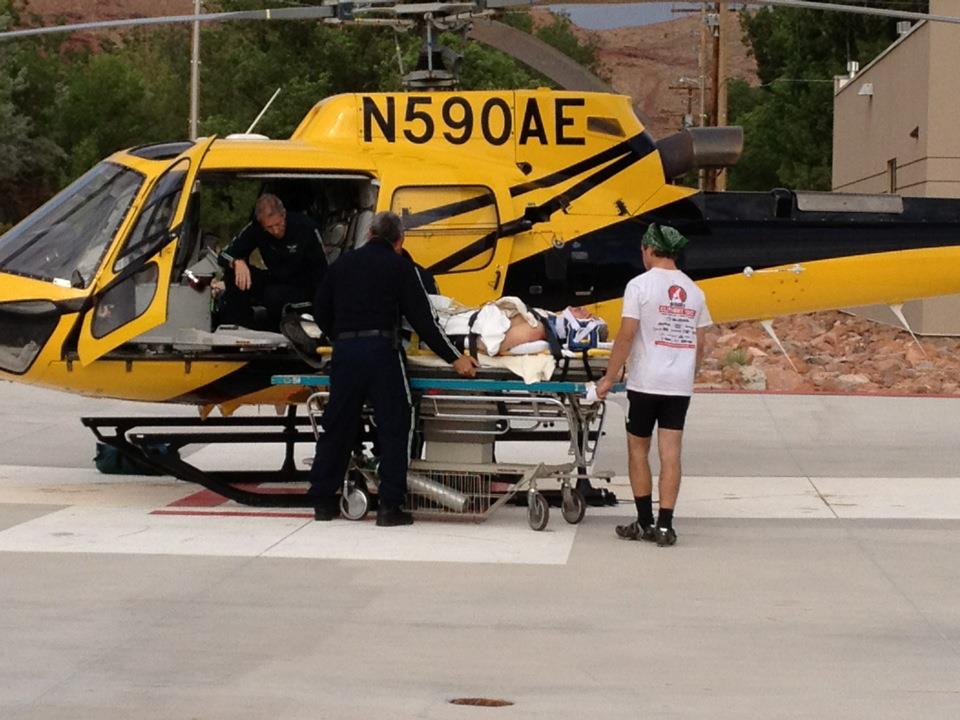
Back on the gurney, out to the helipad, loaded into the chopper and strapped down again. As the helicopter lifted off for the short cruise to St. Mary’s, the chaos of the rescue melted away and I found myself thinking about the gravity of my situation.
I was being handled professionally by the medical experts who saw this sort of trauma all-too-frequently in Moab, but I knew that I was in a fragile state. My neck was broken, and my right arm was gone. There was still plenty that could go wrong. And despite believing that I could still escape Reeves’s fate, the question that came rushing in – that I couldn’t push away – was ‘how much worse is it gonna get?’ Was I gonna lose my left arm, too? What about my legs? Were they gonna stop working before I even got to Grand Junction? And if you go just a little bit further down that line of thinking you come to a pretty dark place. I won’t say it here – I’ll let you get there on your own. But suffice it to say I knew for the first time on a gut level something I’d known in my head for my entire life:
Tomorrow is not promised.
This is me on the gurney being loaded into the helicopter. That’s my then 18-year-old son standing beside me, saying goodbye to his dad with a broken neck.
The image of him standing beside me, doing what needed to be done, being the adult in the situation, was burned into my psyche during that gentle cruise beyond the LaSalle Mountains, northeast toward the Grand Mesa. I wasn’t finished raising him, his sister and two brothers. There were still things I needed to say to those I was close to. There were things I wanted to do with my kids that I hadn’t done yet. I started asking myself whether the things I had been doing that day were really the things I should have been doing.
But none of that mattered. Tomorrow was no longer promised. And strapped into that gurney as I was, there wasn’t a thing I could do about it.
The helicopter landed at St. Mary’s. They wheeled me into the MRI machine, did the test, and wheeled me back out again. The neurosurgeon came over to give me the news: “Yeah, Mark, your neck is broken – in five places. That’s the bad news. The good news is that there’s no spinal cord damage.”
“Thanks, Doc, that’s great news. But my arm is paralyzed…?”
“Well yes, the nerves that control your arm are badly bruised way back up at their roots. But because the bruise is outside the spinal column, your arm will likely recover.”
Sure enough, it was only a matter of hours before I began to regain function in my right hand.
At that point I was given a great gift from the Universe. Now it’s not what you’re thinking. You’re thinking “no foolin,’ Sport. You got to walk away from a broken neck.”
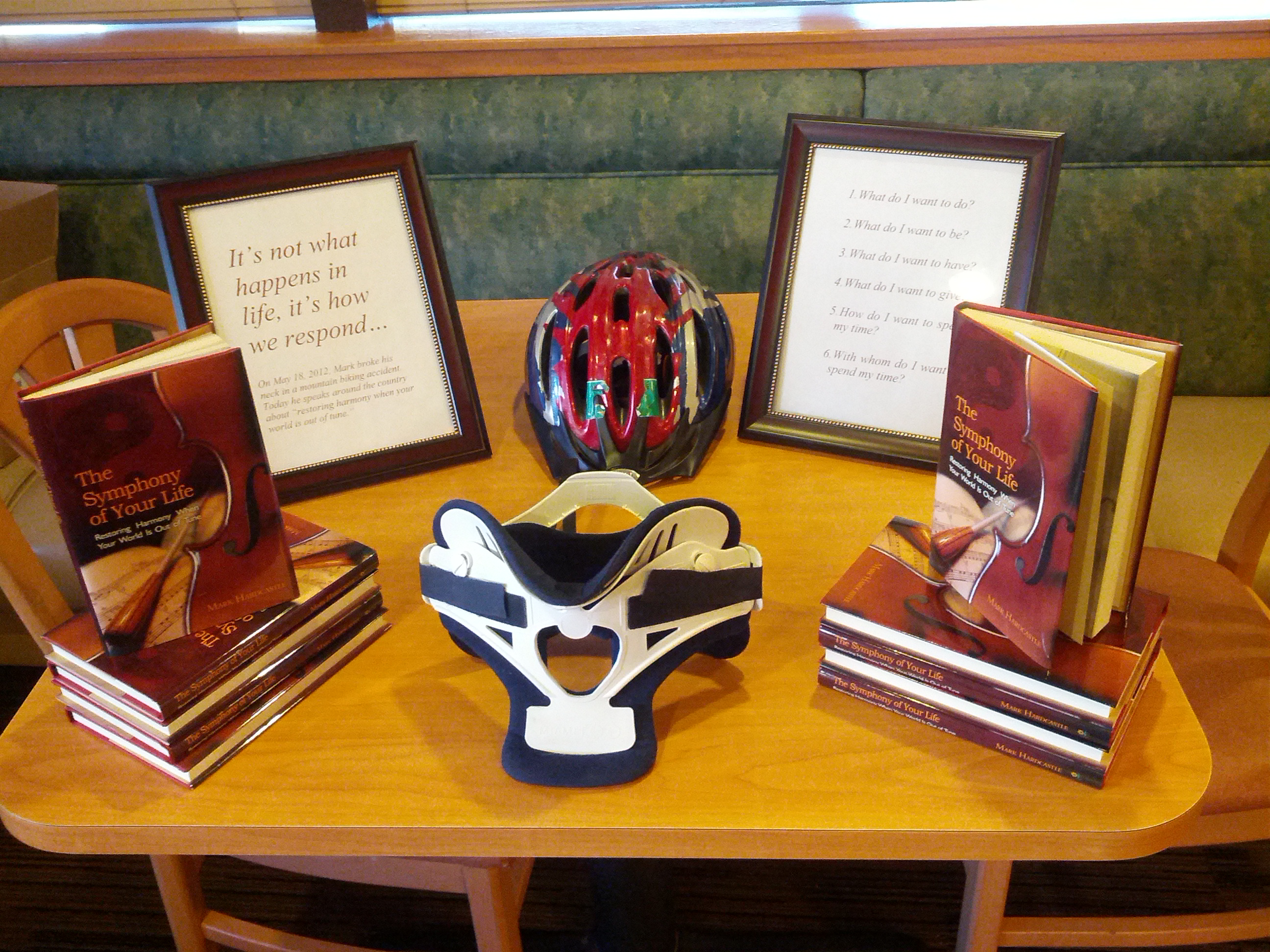
And that was indeed a nice gift. But what I’m talking about is what the surgeon did next. She trussed me up in a cervical collar and told me not to remove it for the next 90 days under any circumstances.
As you might imagine that sort of cramped my style during the summer of 2012. There were things I would have done that I couldn’t do with a cervical collar around my neck. Things I’d have seen, places I’d have gone.
This watershed event had brought my life to a sudden stop. And I was given the gift of stillness for a change. Three months to figure out how to respond to this challenge that Fortune had thrown my way.
So what did I think about during those long days and longer nights of hardly being able to move? I thought of a great friend and pilot colleague. His name happens to be Mark, same as mine. I thought of him for several reasons.
United Airlines, where we both work, is one of the carriers that was devastated by the events of 9/11. As it happened, one of the four captains on one of the four jets that went down that day was a close friend and mentor to my friend, Mark. It was an unimaginable loss. And in the aftermath of that horrific day Mark’s airline declared bankruptcy and cut his pay in half. At half pay he couldn’t make his mortgage payments, and he lost his home to foreclosure and personal bankruptcy. Then a few months before my accident they found two different kinds of cancer in two different parts of his body.
So let’s see. Friend murdered by terrorists. Career disaster. Foreclosure. Bankruptcy. Cancer times two. That’s a heavy list. But you’d never know any of that had happened to him unless you knew it had happened. He’s one of the most positive, optimistic, fun-to-be-around individuals I’ve ever known.
How can that dichotomy exist in any individual? How can it exist in the world?
I asked him that question. Here’s what he said. “You know, sometimes life kicks you where it hurts. And you can either lay there and moan, or you can get up and move on with what’s important.” Simple. Not necessarily easy.
In other words, every challenge brings a choice. You can choose to fight your battles. Or not.
There it was – his response to this Job (the Biblical character)-like series of challenges. He was, and still is, moving forward. And there, through him, was my challenge. Was I gonna lay there and moan, or was I gonna get up and move on with what’s important?
Of course, if you give a monkey three months and enough bananas, he’ll figure it out. So I did. And here I am, still fighting my hard battles – just like you.
Mind if I ask a few more questions as we enter the home stretch?
What watershed event has brought your life to a sudden stop?
More importantly, how are you responding? Are you resolving today, tomorrow, next month, next year to get up and do what needs to be done? Are you embracing the challenges that history has taught us are inevitable? Are you taking the opportunity to create meaning out of those challenges?
How would it be if today as you fight your hard battles you recognized that it’s not what happens in life that matters – it’s how we respond?
A few moments ago we looked to ancient thought leaders for what they had to say about the inevitability of Fortune’s tests. Epictetus, Plato, and Buddha all suggested that we might use their observations as starting points in a conversation about how to find joy in an imperfect world Let’s conclude by going back again to the philosophy of the ages. Further back than all our selected philosophers. Let’s go back 3,000 years to one of the oldest philosophies of all.
The Judeo-Christian tradition expressed in the book of Isaiah promises that if we resolve to do the things we were put on this earth to do, embracing the reality and opportunity of challenge, and fight hard to create meaning out of the inevitable watershed events that bring our lives to sudden stops, then we shall have a song. And gladness of heart.
I think I’m ok with that. I think that’s all I really want. How about you?
Mark graduated from the USAF Academy in 1982. After nine years as a pilot on active duty, he left the military to join a commercial airline. In addition to flying B-737s around the country, Hardcastle spends time in the Rocky Mountains and serves on the artistic staff of the Colorado Children’s Chorale. He lives in Centennial, Colorado, with his wife and four children. Need some help figuring out why you’re on this planet? Want to talk about discovering your mission and purpose? Contact Mark today at 720.840.8361 to schedule a free personal consultation. He can also deliver an inspirational keynote or workshop for your organization! email: mark@symphonyofyourlife.com for information.
Some use clocks. I keep time by the rhythm of The Meadow.
We’ve just passed the equinox on our way to the winter solstice. At it’s highest today, the sun is well off to the south and not nearly as high as it was mid-June. And, as my wife, Judi, described it recently, it feels…”old.”
September is waning, the cottonwoods still almost entirely green against the deepening blue of Colorado autumn. October, prepared in full costume, is just offstage, waiting… Waiting…
In the meantime the fauna in the creeks are busy. Hundreds of minnows bask in the shallows, crawdads carrying their treasures to who knows where. They have a few weeks to finish their work before the streams become cold. Then freeze over. Then turn white.
The harvest isn’t in yet. But my thoughts are turning already to the holidays that will have to be accounted for, with their busyness, leading to the “Sparkling Season” at the solstice.
Today, though, The Meadow is saying, “not so fast!” Today the leaves remain green, the sky is blue. The old sun is still warm.
Some use clocks. I keep time by the rhythm of The Meadow.
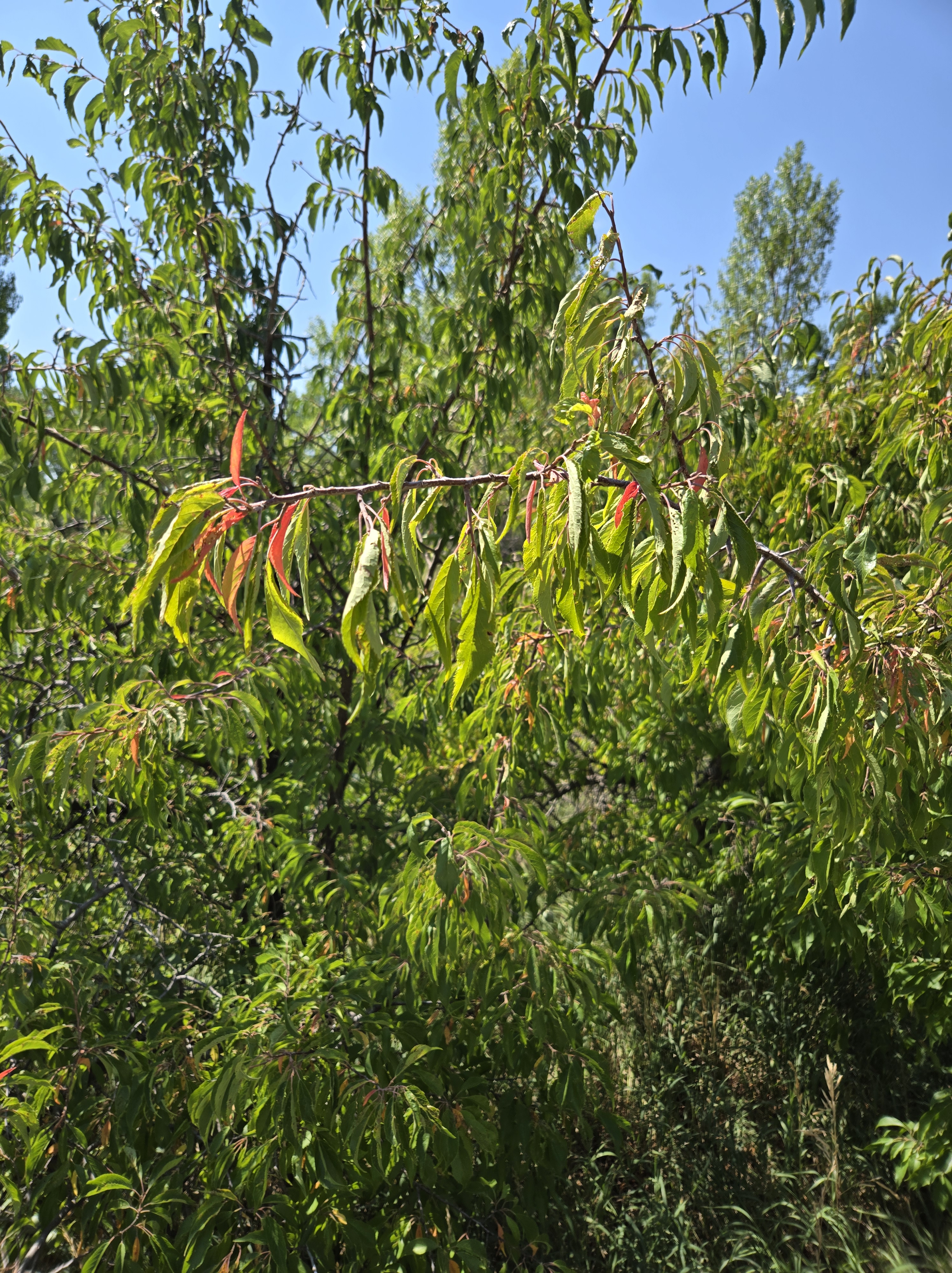
And I am retired. The Meadow is telling me, as always, that time is passing. As always, it challenges me to make good use of my time before it’s gone. The first of these pictures, taken three weeks ago, hints that even though the tree’s fruit is not yet ripe, it soon will be. The second, taken yesterday, says we are further down the road.
And as I saunter along the well-worn path around the wetland that is the Willow Springs Open Space, with its series of beaver dams that always give me pause, it’s still August, and hot. Notably, we’re already two months beyond the summer solstice, and only less than a month from the equinox. And the angle of the sun is such that it has eased off a bit from mid-summer. It’s intensity is lessening. I realize that it’s done it’s work for the fruit trees and is tiring. Though still months away, its rest for the winter is taking its focus the same way a worker with a beach vacation scheduled months away becomes more and more absorbed with the idea.
Which means my walks are more pleasant from an anatomical standpoint. I’m less concerned about wearing sunscreen. I don’t give as much energy to planning for the heat while I’m out.
Another summer, another season, is almost passed.
The Meadow tells me that this is where we are. Where does that put you? I’m still in transition. My last flight with United Airlines was five months ago. I promised myself that I would do nothing – no new enterprises, no new obligations, for at least a year. The idea is that I have a clean slate before me, and I should give it some quiet thought before I start dirtying it up again. I intended to spend the year leaving space for The Universe to speak and have been mostly successful in keeping that promise. Of course, I, being who I am, will eventually get busy again.
But because, as Jane Fonda famously said, “I’m entering my third act, the one that will give meaning to the other two,” I want to write with intention on that slate. For the first time since I was in grade school, there is an opportunity for me to be the only person writing. I should do so with intention – not by accident.
I’ve been asked what it’s like to be unemployed. How does it feel to be “retired,” like an old snorkel truck that is too worn out to be safely operated and is sold off for parts?
The intellectual answer is that I have fulfilled all my obligations to my previous employer who no longer has any claim against my time, emotion, or thinking. At the same time, three of my four children are raised and on their own, with the fourth to follow soon. So there is nothing of significance calling to me when I wake up in the morning. I have fulfilled all my obligations.
One important consequence is that I have no purpose for living. There really is no reason for me to get out of bed at any particular time on any given morning.
The more emotional answer is… “unmoored.” I feel no gravity. There is nothing anchoring me to anything else. I’m a latex balloon filled with helium to neutral buoyancy. Such a thing floats at eye level, unmoving, until someone opens a door, and the air moves ever-so-slightly. The balloon begins to drift. Or the sunlight shifts into the window and the room gets warmer and the balloon rises. Then the air conditioner comes on and the balloon slides gently across the room, rebounds without conviction off one wall, then the ceiling, then another wall, until it cools and descends, so, so casually, to find its original level. And stands still again.
It can be disorienting. I have never in my life been this unstructured, unscheduled. Carried along by the breeze. And when the discomfort of wondering where I need to be taps me on the shoulder when there is no such need, in those times I relax into the truth that the lack of responsibility brings a level of peace. No obligation means no demand.
The day after I retired, I sauntered down to the saint terre of The Meadow, and when my brain kicked in after about 45 minutes of walking, I was struck by a sense of lightness. That lightness led to a profound understanding.
It was there because of what was no longer there.
When I was an airline captain, I carried an awesome and weighty responsibility. I chose daily to lift it. Nobody else made me do it. It was an honor and a privilege, afforded to few, and it gave me a sense of purpose. It made me happy.
Never in all those years did I know how heavy it had been – until it was lifted away.
And there I was, newly retired, on a well-loved trail, experiencing an epiphany of lightness.
Now, five months down the road, with the sun nearly halfway to its southernmost destination, I still feel that lightness. I intend never to let it go. I, being who I am, will gradually pick up commitments and responsibilities, but only those that will be meaningful. In my previous two acts I found meaning in carrying my passengers to their moments that mattered most. That can no longer be my mission.
I need another one.
And so I go back to The Meadow. And listen without searching. I wait for The Universe to speak. I am determined not to engage out of a lack of purpose. Today I have inklings without certainty of what’s possible. My next “Act” will be given to me with great clarity and a sense of purpose attached. I’ll still be retired from my previous life; and retired to something new. I’ll no longer be unmoored. Another summer, another season, is passing. The Meadow tells me where I am. Indeed, it tells us where we are.
Mark graduated from the USAF Academy in 1982. After nine years as a pilot on active duty, he left the military to join a commercial airline. In addition to flying B-737s around the country, Hardcastle spends time in the Rocky Mountains and serves on the artistic staff of the Colorado Children’s Chorale. He lives in Centennial, Colorado, with his wife and four children. Need some help figuring out why you’re on this planet? Want to talk about discovering your mission and purpose? Contact Mark today at 720.840.8361 to schedule a free personal consultation. He can also deliver an inspirational keynote or workshop for your organization! email: mark@symphonyofyourlife.com for information.
A “Symphony of Your Life” blog with Mark Hardcastle
Captain’s Log: February 11, 2022. UA 1119, Denver to Cancun, a very good load. And I got to observe, and participate in, a moment to celebrate after The Age of Covid. Here’s what happened.
With passengers in their seats, almost ready to close the door, I picked up the Purser’s handset in the forward galley, asked my flight attendant Joyce (waving in the picture) to join me at the front of the cabin, and made this announcement.
“Folks, I’d like to take a moment before we get underway to tell you a story. This time last year we didn’t have very many customers. That meant we couldn’t make payroll, and a large cohort of our flight attendants lost their jobs to furlough.
“Thank goodness, the story continues. Later in the year, you all started coming back to the friendly skies. And because you started coming back, we were able to start bringing our flight attendants back to their rightful places in our cabins. And it gives me great pleasure to let you know that all of our flight attendants are now back to work, and I am incredibly grateful to you for making that possible.
“And it gets even better. Not only are all of our flight attendants back, but we’ve started hiring more! And this is where I get to introduce you to Joyce. I want to let you know that our flight to Cancun is Joyce’s very first flight as a fully qualified United Airlines flight attendant. (I turned to Joyce and continued.)
“Joyce, welcome to United Airlines! I’m honored to be your Captain for your very first flight, and I’m grateful to have you on my crew. (Back to the passengers.)
“Folks let’s welcome Joyce to our flight and her new career! *Applause*
“Thank you all for honoring her that way! We’ll be underway shortly!”
With that, Joyce went back to closing the bins; I stowed the handset, returned to the cockpit, called for the “Before Pushback Checklist,” and we, that is, all of us, especially Joyce, were on our way.
Here’s the funny thing. I can think of at least two previous occasions when I commanded a first flight for a flight attendant. Neither time did it occur to me to make a big deal out of it. I should have. Why didn’t I?
I can speculate, but it really doesn’t matter. We all show up as best we can on any given day. On those other days I wasn’t ready to show up the way I did for Joyce. I’ve grown as a Captain since those days to the point that my best was better on the current occasion.
And here’s my promise and a challenge. I will continue to grow and learn and do my best to be better. Will you?
But then again, was that the real lesson in this experience? Maybe not…
Maybe the best reminder was that the Wheel of Fortune turns. Sometimes we’re at the top, like when all those furloughed flight attendants were initially hired. That was a moment to celebrate.
Then the Wheel turned, and we all found ourselves at the bottom. And we all had the option to jump off the Wheel and call it a day.
But the Wheel turned again. And all of those who stayed in the process are now back at the top. And isn’t that the real message from Joyce, and all the other flight attendants who have come back to work?
I hope as you ultimately find yourself at the bottom of the Wheel again one of these days, you’ll remember Joyce. And the many flight attendants who stayed with it during The Age of Covid. And you’ll stay in the process, too, until you find yourself reigning again at the top of the Wheel.
Thanks for reading!
Captain Mark
L-R: Ronna, The Captain, Larry, Debonney, Joyce, and Kelly.
Mark graduated from the USAF Academy in 1982. After nine years as a pilot on active duty, he left the military to join a commercial airline. In addition to flying B-737s around the country, Hardcastle spends time in the Rocky Mountains and serves on the artistic staff of the Colorado Children’s Chorale. He lives in Centennial, Colorado, with his wife and four children. Need some help figuring out why you’re on this planet? Want to talk about discovering your mission and purpose? Contact Mark today at 720.840.8361 to schedule a free personal consultation. He can also deliver an inspirational keynote or workshop for your organization! email: mark@symphonyofyourlife.com for information.
A “Symphony of Your Life” blog with Mark Hardcastle
In a previous post with a similar title, I wrote about the importance of accountability along with grace when, for whatever reason, we show up with less than 100%. My dear friend, Captain Luis Perez, thought the article was maybe a bit simplistic and wrote in to offer some additional context.
Whenever Luis speaks about how our brains perceive and respond to stimuli I listen. He has spent much of his adult life studying what has become popularly known as “mindfulness.” Mindfulness in and of itself is a good thing, Luis might say. But it’s not the goal. The goal is “awareness without judgment.” Mindfulness is a tool that leads to awareness. Awareness without judgment leads to better response.
The “100% of 80%” article dealt primarily with attitude, and it remains valid as far as it goes. I wrote there that in the real world we sometimes just don’t have our full capacity for any number of reasons. This was in response to a Headspace program in which the host suggested that we simply choose to be ok with whatever capacity we happen to have on that day and leave it at that.
I thought that was too easy. I offered that our best response would be a determination to give 100% of whatever capacity we show up with.
Luis suggested that I might have misunderstood. In fact, Luis imagined, the Headspace host was going far deeper than addressing our attitude. He was pointing out that when we recognize that we’re not performing up to standard, such a normally healthy circumstance can create a less-than-helpful mental state and an internal conversation that spirals toward even worse performance if we can’t let it go. That would not be an ideal response.
Importantly, it might have more to do with awareness than attitude, and according to Luis’s thinking, that was likely what the Headspace host was addressing. He was saying it’s good to recognize the situation, then accept the fact, be ok with it, and move in the direction of repairing rather than kicking ourselves. I’ll buy that.
I continue to maintain that attitude is an important component of performance. That’s my “Type A Captain” coming out. Luis agrees that excellence begins with attitude, and he points out that awareness is the next necessary evolution for best performance. My Type A self is listening.
Since he can bring his full 100% to the conversation, I’ll let him take it from here. His note follows, edited for clarity and brevity.
“Hi Mark,
I always like reading your Captain’s logs. They inspire me and make me reflect. Here are some reflections about your “100% of 80%” article.
Unless we are aware of every thought bouncing around in our minds moment to moment, how do we know we are providing 80, 90, or 100% of our attention to what is happening right in front of us in real time? (Captain’s note: Actually, we probably aren’t and don’t. In the previous chapter it took Coach Bob to bring that reality to his player’s attention. So we might need some help with recognizing what’s important in a given moment. Luis explains further…)
According to most research, on average “we are missing 50 percent of what is happening in front of us.” (Amishi Jha, Peak Mind: Find Your Focus; Own Your Attention; Invest 12 Minutes a Day, HarperOne, 2021) Incredibly, when you think about it, we are still able to accomplish many tasks like driving cars and flying airplanes while not having our full attention on what we are doing with our bodies. As a matter of fact, I am sure you have written many articles in your mind while still driving home from work.
The practice commonly known as meditation that you are now engaged in using Headspace is what will slowly increase your awareness of what is happening in your brain, that is, all the incoming data together with your subconscious processing, that is taking your focus away from the present moment.
Because our thoughts and emotions are an ever-present threat to our attention system, constantly tugging our attention away from present moment awareness, sometimes we might not “show up with 100%” for what we are attempting to accomplish at that moment. We might miss an important detail or make a mistake.
And then we catch ourselves. Or, in the previous example, Coach Bob notices and brings it to our attention. At that moment of noticing that something isn’t right, the recommendation to “recognize it and be ok with it” has more to do with acknowledging the mind pattern that will be created by “not being ok with it,” rather than with acceptance of mediocrity. And, I would argue, the patterns created by “being ok” and not “being ok” are opposites and may result in very different outcomes regardless of attitude or intent.
While I wasn’t there, I know Coach Bob, and imagine that the way he told his player to “get back out there and give me 100%” was encouraging rather than accusing. And I’m sure it had the effect of returning the kid’s mindset to the task on the field rather than sending his brain into guilt and self-recrimination. But what if Coach Bob had a different style and chewed the kid out rather than steering him back to proper awareness for the moment?
The problem is that if we hold ourselves to a standard of 100% effort and attention 100% of the time, we might find ourselves getting disappointed or upset when we don’t meet that standard. The moment one gets upset or disappointed at not having shown up at 100%, or put another way, the moment one decides to hold oneself accountable in the traditional sense, is the moment when a less-than-helpful mental loop is likely to begin. That loop has the potential to take our attention even further from what we are engaged in. That, of course, is not the desired response to a mistake!
This is not to say that 100% effort and awareness is not a worthy goal. It is to say, however, that being human, it’s unlikely we’ll be in a place to give it 100% of the time. How we respond to that understanding makes all the difference.
In other words, if we are flying and we make a mistake, should we beat ourselves up about it for whatever period of time before we set about repairing the mistake? Or should we keep flying the aircraft with our full attention on what is happening in front of us, maybe repairing the mistake right away rather than taking even a small amount of time to dwell on the error itself? The aircraft will certainly not wait for us to think about the mistake for too long before things can start to go bad.
The recommendation from the Headspace host would probably be something along the lines of “note the mistake, be ok with it, and keep flying. Once on the ground, debrief, evaluate, and learn.”
Cheers,
Luis”
Cheers, indeed, Captain! Thanks so much for taking the time to share your wisdom!
And there you have it, folks. Captain Luis and I agree on the need for personal accountability. As he often does, he has given me a clearer understanding of how that might look in an ideal world. And, of course, how we can move ourselves in the direction of manifesting that ideal situation more and more frequently until it becomes the default response when things start to go bad.
Awareness without judgment. Move toward repair rather than recrimination. That’s the goal. Can we be ok with that?
Mark graduated from the USAF Academy in 1982. After nine years as a pilot on active duty, he left the military to join a commercial airline. In addition to flying B-737s around the country, Hardcastle spends time in the Rocky Mountains and serves on the artistic staff of the Colorado Children’s Chorale. He lives in Centennial, Colorado, with his wife and four children. Need some help figuring out why you’re on this planet? Want to talk about discovering your mission and purpose? Contact Mark today at 720.840.8361 to schedule a free personal consultation. He can also deliver an inspirational keynote or workshop for your organization! email: mark@symphonyofyourlife.com for information.
A “Symphony of Your Life Blog” with Mark Hardcastle
Captain’s log: February, 2022. I’m in Orlando on my own dime, listening for what The Meadow might have to say.
Yeah, I know. We’re usually down in the Willow Creek Open Space in Colorado. But The Meadow travels with me and speaks to me wherever we happen to be. Today we’re sauntering through Constitution Green, a tiny park in central Orlando that I discovered years ago, and now visit faithfully whenever I’m here.
How could I not? This live oak tree is estimated to be over 200 years old. Its massive arms dive to the ground, then spring back up into newly supported trunks. It’s a wonder. And so I do.
After all, some use clocks. I keep time by the rhythm of The Meadow. And this old tree records the passage of time on an entirely different scale. Those records contain treasures to be picked up, turned over in hand, and pondered.
As I pondered this morning, here’s what the old tree had to say.
“Life will be hard later if you don’t pay the price today to become valuable tomorrow. Life will be hard today if you do pay the price, but delaying gratification today will ensure that tomorrow’s possibilities will be endless.”
Two centuries of wisdom walking with my six decades of stories that carry lessons of their own. Some in my world think I’m “old.” But I’ve got nothin’ on this guy. He gave me good stuff today. Now I’m giving it to you.
Mark graduated from the USAF Academy in 1982. After nine years as a pilot on active duty, he left the military to join a commercial airline. In addition to flying B-737s around the country, Hardcastle spends time in the Rocky Mountains and serves on the artistic staff of the Colorado Children’s Chorale. He lives in Centennial, Colorado, with his wife and four children. Need some help figuring out why you’re on this planet? Want to talk about discovering your mission and purpose? Contact Mark today at 720.840.8361 to schedule a free personal consultation. He can also deliver an inspirational keynote or workshop for your organization! email: mark@symphonyofyourlife.com for information.
A “Symphony of Your Life” blog with Mark Hardcastle
Captain’s Log: autumn, then winter 2020 on random days off.
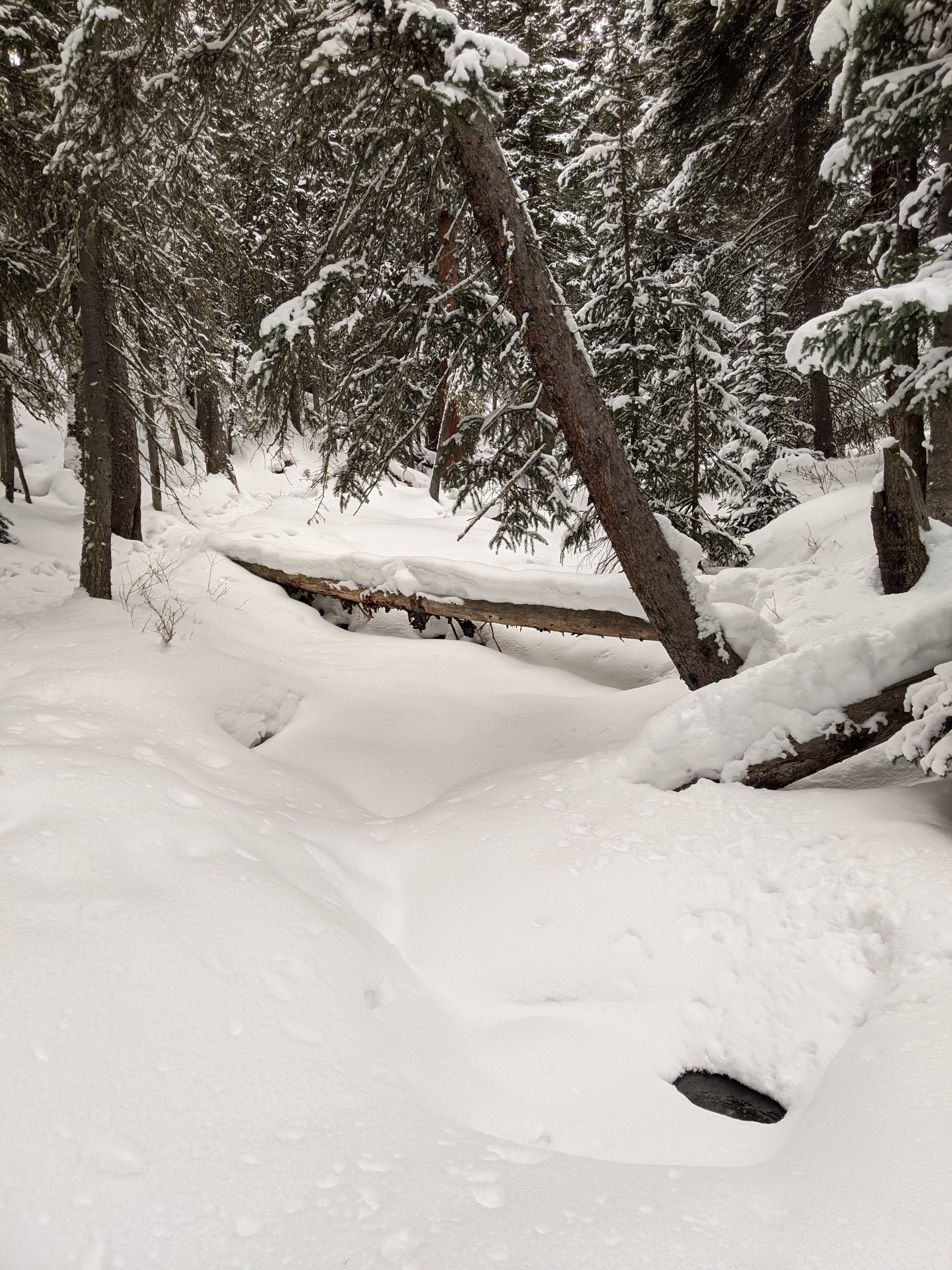
If you are able to get outside – way outside – which is to say, far from the madding crowd, you’ll come across a creek somewhere, moving down a hill, with a purpose. And if you take a moment to be still… and mindful… of the sound it makes, you’ll recognize that there’s something… important… about the sound of a creek in a Rocky Mountain forest. In autumn, and in winter.
Mark graduated from the USAF Academy in 1982. After nine years as a pilot on active duty, he left the military to join a commercial airline. In addition to flying B-737s around the country, Hardcastle spends time in the Rocky Mountains and serves on the artistic staff of the Colorado Children’s Chorale. He lives in Centennial, Colorado, with his wife and four children. Need some help figuring out why you’re on this planet? Want to talk about discovering your mission and purpose? Contact Mark today at 720.840.8361 to schedule a free personal consultation. He can also deliver an inspirational keynote or workshop for your organization! email: mark@symphonyofyourlife.com for information.
A “Symphony of Your Life” blog with Mark Hardcastle
Captain’s Log: Any given day in the terminal.
My customers have little say in the outcome of our “joint project.” It’s all up to me as far as they’re concerned. Many never give that reality a second thought.
Some, though, have yet to come to terms with climbing into an aluminum tube with 172 other humans, accelerating to 80% of the speed of sound, ascending to 6 miles above the earth’s surface, cruising quietly for a couple of hours, and arriving hundreds if not thousands of miles from where they began. How do I give them confidence it will end well/successfully?
Something I learned in Captain school is that everything speaks. Everything I do conveys a message of some sort. Which means that as I walk up to the gate my passengers are watching, and I’m saying things without ever speaking a word.
Unfortunately, I’m not the prettiest guy in the concourse, so I’m at a disadvantage when it comes to creating a good first impression. But I do what I can, even in that moment. I show up in the best possible way on that particular day. My hat is in place, my blazer buttoned, my shoes shined. I approach the boarding area with all the dignity I can muster. It’s the least I must do and the best I can do to transfer a sense of confidence to my passengers.
Of course, there will be more later. In just a few minutes I’ll pick up the microphone to welcome them to our flight. The surface-level information contained in that greeting will be all the standard things you’ve ever heard from any other Captain on any other flight – time en route, weather at destination, etc.
My subconscious message, very intentional even if subconscious, will be conveyed by the act of allowing them to lay eyes on me and hear me string a few words together. If I’m successful, they’ll come to the conclusion that “this guy looks and sounds like he knows what he’s doing. It’s not his first rodeo.” And their stress level will go down.
And I can almost feel your eyes beginning to roll. You may be thinking that Captain Mark has succumbed to delusions of grandeur. He’s just the guy flying the plane. It really doesn’t matter how he walks up to the gate, nor what he says. Nobody cares.
You may be right. And yet…
The very last event of my transition training from first officer to Captain was a check flight in the simulator. The session included a briefing from the evaluator about what was going to transpire during the ensuing several hours. It also included some philosophy about excellence, and how to go about becoming the best we have the potential to be.
Part of that conversation included a bit of commentary about how to wear the uniform well. He remarked that as we walk through the concourse people are watching, and they’re thinking, “I hope that guy’s my Captain,” or… not. And he suggested that they’ll be coming to those conclusions because of the way we carry ourselves and wear our uniforms. I thought that was nice and got the point. But I didn’t think for a minute that he was being literal.
Until that morning in Boston.
During summer operations most airlines offer pilots a “summer option” for how to wear the uniform. If they so choose, pilots are allowed to go to work without the hat and blazer. It’s a much more comfortable option in hot weather. And more casual-looking.
One summer morning in Boston my first officer and I chose to show up in our full uniforms; hats in place, blazers buttoned, shoes shined. Most of the other flight officers in the terminal were wearing their summer option, so we kinda stood out a little.
Shortly after we arrived at the gate I picked up the microphone and began doing my best to transmit all my messages. That complete, I stepped over to the boarding lanes to greet my passengers individually (this was pre-Covid).
One of my business-class passengers took my outstretched hand and said he’d appreciated my welcome message. And that he had seen the two of us in the terminal and had remarked to his traveling companion that “I hope those two are our pilots.” I smiled genuinely, thanked him for the compliment, and looked to his friend. “He didn’t really say that, did he?” “Oh yes, he really did.”
Incredible. Not in a million years would I have thought that what our evaluator had said could possibly manifest in the real world. But there it was.
Which begs a few questions for you.
Who is in the back of your airplane, and literally along for the ride? (This would be anyone who is dependent on you – employees, business partners, team mates, family members.)
What kind of hard battles are they fighting? What anxieties are they dealing with? Why are they about to board your jet?
Now… What can you do to lower their conscious and sub-conscious stress about the flight? How do you speak to them without ever uttering a word? And what are you saying when you do?
They’re counting on you, and they know it. And everything speaks.
Mark graduated from the USAF Academy in 1982. After nine years as a pilot on active duty, he left the military to join a commercial airline. In addition to flying B-737s around the country, Hardcastle spends time in the Rocky Mountains and serves on the artistic staff of the Colorado Children’s Chorale. He lives in Centennial, Colorado, with his wife and four children. Need some help figuring out why you’re on this planet? Want to talk about discovering your mission and purpose? Contact Mark today at 720.840.8361 to schedule a free personal consultation. He can also deliver an inspirational keynote or workshop for your organization! email: mark@symphonyofyourlife.com for information.











 The Symphony of Your Life